Showing posts with label History. Show all posts

Sunday, August 23, 2015

History in Lights

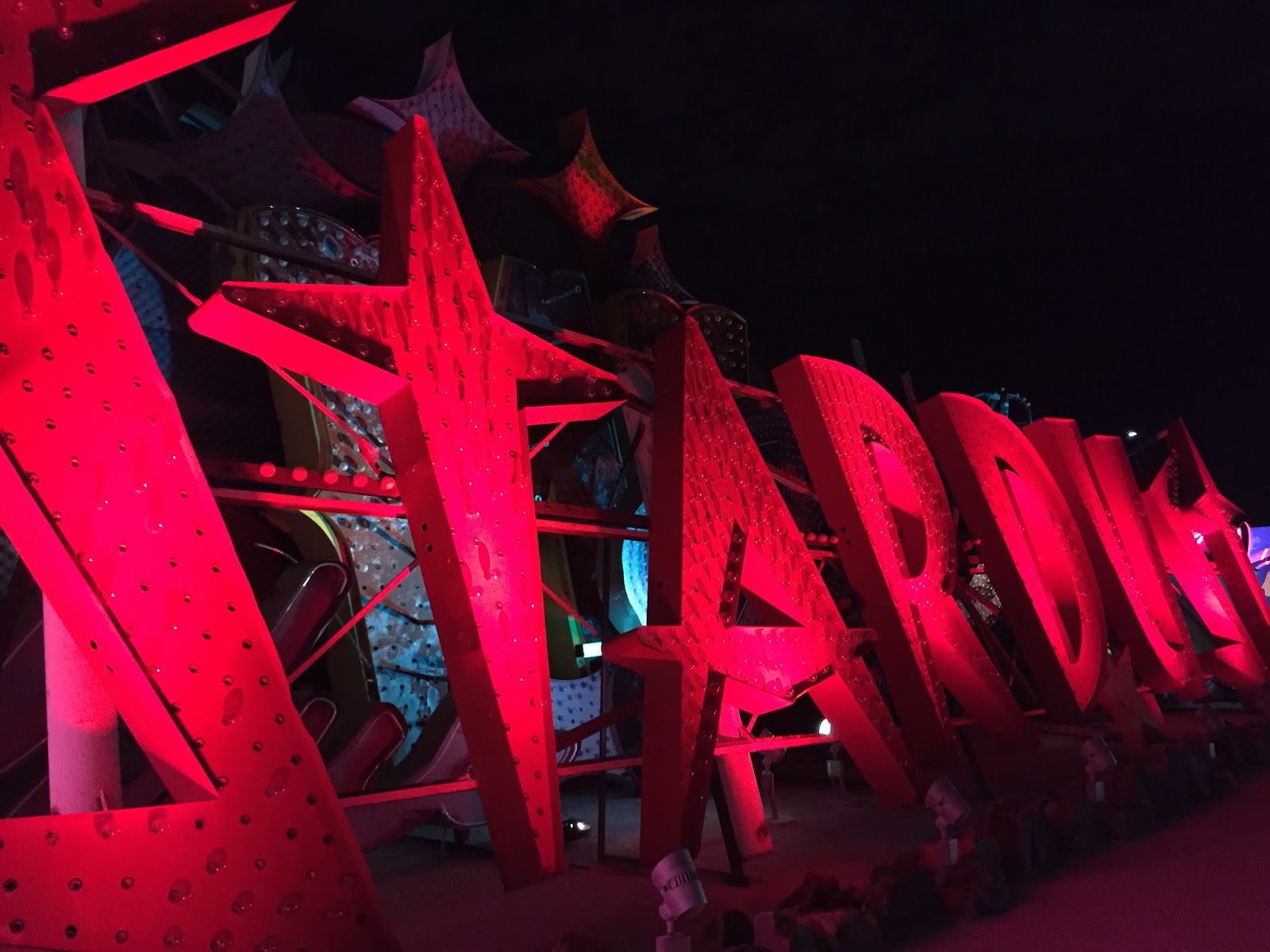
What happens when the lights go dark? In Las Vegas, several sets of lights go out every decade. In fact, one grand set of lights that lit up the Riviera just went out this year. Only a couple of months ago, you could still see the neon sign, ghostly dark with shadows and reflections from the lights of the other casinos nearby. Despite the command to pull the switch, bringing darkness, the Neon Museum is waiting nearby to offer a second chapter for those that faced the last curtain call. 

The glitz and glamour of  the Las Vegas strip is always tinged with a sense of déjà vu: As if you’ve seen the extravagance before, perhaps just around the previous corner, or in an old movie from decades ago. The glitter and lights have provided a backdrop of resplendent euphoria. Of course, this effect is intentional, to make you feel prosperous, beautiful, uninhibited, and timeless. But just as pockets empty and beauty fades with age, so too casinos fade in popularity and age tarnishes the shine of the flashing lights.
As a reminder of all that glitters is far from gold, the Neon Museum strives to preserve the essence of Las Vegas, from its early days to the present. With each casino that is shut down, the Museum is at the ready, hoping to secure a piece of the sign for their "boneyard." 

Over the years they have collected many remnants of neon artistry. Not many are in working order, but each comes with stories as big as the current towers of light still shining on the strip, just up the street. That was the first thing that caught my attention during our visit. Standing in the dark, waiting for the tour to start, and seeing the glow on the horizon from the current casinos that have risen up to take the place of the past signs we were about to see. A reflection of humanity and life itself that was too uncomfortable to speak out loud. Most waited in respectful silence, as if we were about to enter a cemetery.
Visitors are encouraged to purchase tickets well in advance as tours sell out quickly. But the tour choice is part of the experience. Tours can be taken during the day or during the night. As a Neon Museum, I figured the neon signs viewed at night would make for the best experience. In hindsight, I now realize either tour would have distinct advantages. While the night tour provides an atmospheric experience of echoes and shadows, the daytime tours would provide an artistic experience of mid-century modern marvels. Many of the signs on display are from the very era of Betty Willis’ famous “Welcome to Fabulous Las Vegas” sign that has become a timeless icon of this city: impressive in either the light of day or light of night.

The endeavor that evolved from a Neon Boneyard into a Neon Museum began very small and has grown significantly over a brief number of years. Still, the effort, talent, and resources necessary to bring darkened neon signage back to its glowing glory does not come easy. Each sign is unique in construct, and only shines again after a lengthy labor of love. This slow and costly process means their collection of broken signs vastly outnumbers their collection of brilliantly resurrected signs. 
During the night tour, visitors are guided through a maze of neon art. Sizes, colors, shapes, textures, and messages are as varied as the current array of signs seen on the 21st century strip. But time is always a variable, as evidenced by the patches of rust alongside the brilliant residue of paint and glass. Since Las Vegas is only a little over 100 years old, their earliest signs only go back to the 1930s and 40s. Not only do visitors experience the variance of light and color, but design and construction changes enhance the stories told by the guide. 
Celebrities, gangsters, and early restaurateurs provide the history, but the contours and shapes provide the visual record of 20th century sign making. As only a few of the signs have been restored to fully functional operation, the museum has chosen to light the signs and paths with colorful spotlights that create depth and atmosphere. The darkened shadows with hints of light and color truly echo a time past. Despite the name change from "boneyard" to "museum" there was a sense of cultural death, and many locals still refer to this place as the “boneyard.” Each decade of decadence has put its mark on this city in the form of massive light structures, meant to lure visitors with the promise of riches. But the riches are ethereal, rarely realized, and often out of reach. 
And yet, the lure is still alive. New signs replaced the old, and today’s lights are vastly bigger and brighter. As we walked along in the dark desert air, names of legendary casinos were spoken once again and visually represented by a small remnant of their neon luster: The Golden Nugget, The Silver Slipper, The Stardust, The Sahara, and an older version of Caesars Palace. Note the lack of an apostrophe. The guide reminded everyone that Caesars Palace is named in such a way as to declare that all visitors are wealthy Caesars and this is their Palace.
Each new decade strives to make the impact larger and more breathtaking than the previous, to lure more visitors, with even greater promises. At the Neon Museum, the echoes of past decadence are felt poignantly with each turn of the path. As a result, the beauty in this colorfully lit visage reminds us of the uniqueness of Las Vegas. Everyone comes to Las Vegas for the experience, regardless of what we win or lose here. It is a special place unlike any other, and purely an American mirage built out of the desert. 

P.S. The museum is currently raising funds to restore its newest acquisition, The Desert Rose. They have one week left to reach their ambitious goal! Please consider donating to this groovy cause! 

Tuesday, July 15, 2014

PSA: Backward Balloons

This Public Service Announcement is brought to you from the past. The little girl in the photo, proudly holding a balloon, is me. The year is probably around 1979 or 1980. My Mother and I are standing outside our Church in Cincinnati, ready for the yearly Vacation Bible School balloon release. This annual tradition served as the kick-off for VBS, and provided two weeks of wonderment for children who eagerly anticipated the return of the cards attached to said balloons. The contest was simple: each balloon had a card attached. As the balloons popped at the end of their journey, we hoped someone would find the card and mail it back to the Church. The winning balloon was the one that had traveled the farthest.

This tradition went on for years....but I remember when it ended. There was a shift in collective opinion regarding the environmental safety of releasing dozens, hundreds, or thousands of balloons into the atmosphere. Once we understood the impact of these repeated and widely popular actions, we just stopped. In fact, several states went as far as to make such releases illegal: California, Connecticut, Florida, New York, Tennessee and Virginia. In Kentucky, such releases are currently illegal in the city of Louisville.

Unfortunately, I have noticed a huge resurgence in this activity. In 2014, the activity appears to be almost untouchable or irreproachable due to its connection to mourning. It has become the new go-to celebration of a life passed. Yes, I will admit, such releases are beautiful...but the brief moment of beauty does not erase the harm inflicted on wildlife that may come across the balloon remnants once the pieces fall back to the earth.

When history does repeat itself, sometimes the same horrible results follow. I am saddened that we are taking a step backward to make the same mistakes of the past. Instead of celebrating a life passed by releasing dozens of items that could bring death to other creatures, why not come up with alternatives? Some have suggested doves or butterflies or even bubbles. While gardening the other day, I had thought of ladybugs. Gardeners purchase these beneficial little bugs on a regular basis as a natural balance of power when battling flower pests.

Some will argue that this concern is no longer valid because of two things: 

1. The balloons are made of latex which is a natural substance and biodegradable: Not really - natural latex could be, but it takes 6 months for a natural latex balloon to decompose - plenty of time to adversely affect an animal. Most released today are not natural, but modified to decompose after years of exposure.

2. The helium inside the balloon takes it to a height that shatters the balloon's surface, thereby removing the danger of larger pieces falling to the ground: Not really, this can happen in some cases, only if every balloon is tightly sealed or tied closed. If the closure is loose at all, the pressure can cause the end to open and the balloon floats down intact. However, you cannot seal them with anything but the balloon bottom - any other closure, such as string, plastic, or tape is regarded as non-biodegradable and littering according to most local laws. Plus, even the shattered pieces can be large enough to choke a small animal. 

***One special note about closures, strings, or tags: Non of the aforementioned items should be used if you do make the sad decision to release balloons. Unfortunately, when viewing some local releases here in Kentucky, I have observed strings or ribbons attached to the balloons when let go. Which tells me this new and hazardous retro-fad has not even been researched prior to the organization of such events.

For those of you who have lost loved ones, I have every sympathy for your loss, and believe you should celebrate their life in beautiful, grand gestures of love. However, in the case of balloon releases, please take that off your list, and try to think of a celebratory gesture that will not harm the environment or accidentally take a life as a result. Please pass on this word of knowledge from the past. I implore you to make a different choice BEFORE this new collective activity takes too great a hold!

For more info: http://balloonsblow.org/

Saturday, January 18, 2014

Free Event Tool: The History List

Introducing a new FREE Event Database: The History List @ thehistorylist.com (Don't forget "The"). I've been meaning to post about this new free event tool for awhile, but have been consciously giving them time to get more established. For those who run historical/genealogical organizations and museums - and for those to love attending events at said institutions, you owe it to yourself to check out this new free tool to list your events! So far, they have attracted organizations from around the country, and list history related events by state and/or chronologically.

Based out of Massachusetts, the majority of events listed in The History List, are from the New England area, but they are adding events from new states all the time. The Kentucky Historical Society has had their events listed in this database for over a year now, and we have enjoyed its easy integration into our main web site

On a personal note, I have to add events into the database for KHS on a regular basis, and have observed the following:
1. Each organization has a home landing page with general information and list of upcoming events + Each event has it's own page with an unlimited photo/video option to showcase the event visually.
2. The event pages are easy to read with event location (with map integration), cost, description, event Twitter hashtag, and intended audience information intuitively placed. 
3. Event duplication and repeat planning are a breeze.
4. Events can be added once on this site, with code pulled into your main web site or through an easily generated widget - see one example here on this blog - for KHS events - far right sidebar.
5. Events are searchable by location or event type.
6. ANY Historically related organization that hosts events can join for free to add their content - including Historic sites or parks.
7. Due to their relatively young age, there are some bugs that you should be patient with: Tagging is integrated, but searching does not seem to pull out related events unless the search term is in the title. Event creation can get a little odd with font appearance changing once "publish" or "preview" is clicked. Widgets and coding can have a learning curve or some browser irregularities.
8. Small company, but very willing to work with new organizations to resolve any issues and get feedback for improving the product.
9. Did I mention this is FREE, and provides a place to list History related events? As a History buff, I LOVE this concept and would love to see more organization events listed here. 
10. What a great way to promote the events of smaller organizations that have little to no budget!

Anyway, don't take my word for it....read through the features, and if you belong to any historical/genealogical/museum related organizations, bring it to their attention!
For more information, see this page: How the History List is Different  
For some event reminders, don't forget to follow them on Twitter! @thehistorylist 

Saturday, June 4, 2011

Inferential Genealogy Homework #1

During my previous post about Second Life, I mentioned the current course discussions being held in-world, and how they would require some homework blog posts. Before you non-SL people read this and rush off, this seminar is available online for anyone to complete. The only difference with my posting will be the connection to Second Life discussions. If you would like to utilize this free course on Inferential Genealogy by Dr. Tom Jones, offered through the free online courses by Family Search, here is the direct link: http://broadcast.lds.org/elearning/fhd/community/cbig/player.html

Also, here is the original post about the course and Second Life schedule from Dear Myrtle - the dear who has brought this to our attention and is willing to host discussions in-world!
http://blog.dearmyrtle.com/2011/05/inferential-genealogy-study-group-in.html

Our first post discussion assignment required us to write a blog post about our understanding of inferential genealogy at this stage of the course. Also, we are to include any examples we could think of from our own genealogical research.

As far as my understanding goes, inferential genealogy is the method of drawing kinship/relationship conclusions based on partial or piecemeal information. As genealogists we utilize all kinds of factual records - most are accurate, but many are flawed, or even wrong. Since no one document can give us the solid, complete facts about an individual, we must turn to many outside sources to confirm any conclusion we might draw. Dr. Jones describes it as putting together a puzzle. We only have the complete picture after we have put together all of the pieces.

Honestly, after viewing the introduction and reading the handout, I suddenly realized that this is always how I have conducted my research. Perhaps this is due to my past experience as a history major back in my undergrad days, when we learned to never really take history at factual face value. We were taught to check and double check multiple sources (primary sources) and then take the facts we learned and put them together in contextual perspective. In other words, we could only draw reasonable conclusions after multiple sources had confirmed the perceived information and as long as it fit within the context of the period from which it came. After learning this type of methodology I applied it to my genealogy research methods - thereby rendering almost ALL of my genealogy research into a state of limbo or suspicion.

I don't care if my great great aunt told me what her mother's maiden name was, I need multiple records confirming her information (and spelling) before I would conclude it to be fact. Does this mean I did not value the information that was given to me via an oral interview? On the contrary. I am a huge proponent of oral history and interviews. If you want to know where to begin your research journeys, oral interviews are the absolute best place to start - not to mention that at face value they are primary sources when wanting to understand a people, their perspective and cultural experiences. Plus, most of the time, those oral interviews are pretty darned accurate - I love them dearly, and in my opinion, they are more precious than the records, because they represent voices and impressions of the lives that came before me!

So, back to true inferential genealogy and how this has helped me. Since my research is never complete, any piece of information, however small or insignificant, is a puzzle piece that helps me paint a complete picture of an ancestor's life. Even if I have already confirmed in a few records the birth date of a person, by employing the strategies of inferential genealogy, I can put more flesh back on the bones per se. Dr. Jones outlines steps to using this method, and one of his steps involves broadening your research area and scope. Thereby studying the neighbors of your ancestors, community involvement of your ancestors, and migratory patterns that include a whole new set of broadened areas of research. But seriously, when I began my genealogy journey so many years ago, it wasn't the birth and death dates that got me hooked, it was the life led by my ancestors that inspired that passion. The life truly led can really only be found through inferential methodology.

To give a few examples of how I used this method within my own family research:

1. My great great Uncle Lanson Cox died as a young man in his 20s. The story of his death came from my great Grandmother - she mentioned that he died young and that she was very close to him, but never detailed the experience. I used death records to see his death date, cause of death and parents - plus tombstone and other records to confirm his birth/parents, etc. However, the experience of losing a brother at such a young age was the more complete picture. I used local newspaper gossip sections that detailed his lingering illness over the weeks and months. These not only gave me a better understanding of how long he was sick, but also allowed me to see how the community was handling the illness of a local. They detailed when his family members and neighbors visited, and how many local friends visited, always describing how well liked he was in his small community. Later, obituary notices helped detail and confirm some of the familial relationships mentioned earlier. This inference of family connection is a breadcrumb or puzzle piece that can help me later add more members to our family tree once the relationships are confirmed through more sources.

2. On my Beyersdoerfer side of the family, my 3rd great Grandfather was quite adept at alphabet soup. He was born Johann George and immigrated to America with his brothers in the mid 19th century. However, it seems he not only changed to John George once he landed, but also preferred the name George when dealing with some records (not all) due to the other local John Beyersdoerfers in the area. He therefore used the following given names/initials: J.G., John, John George, G.J., George, and even Johann George in his earliest records on American soil. By the time he died, he had G.J. listed on his tombstone. This man's life can ONLY be documented through inferential means. Due to the other Beyersdoerfer immigrants in the same surrounding counties, I can only count a record as truly being that of my Grandfather if other pieces within that record coincide or match details from other records. In many cases, I really can only count those with the same immediate familial relationships on the record to consider it his.....and even then, I double check birth dates of those family members due to a repeat of given names within this group of German settlers. Ugghhhh!!!

3. One last example from my 3rd great Grandfather Samuel Cox. He was married three times, and no one in the family can ever seem to get the names of the wives straight. Plus, two of the wives had the same given name and died within a few years of each other. Needless to say, I must rely on inferential info to confirm when I have a record about a specific wife. And don't get me started about those in the family who confused the son Samuel with the father....we soooo need a Cox family history do-over! Especially for what is lurking out there in the interwebs!

In conclusion, I really do not believe you can adequately paint a complete portrait of your ancestors, nor understand them, without using this method. It leaves no stone unturned, greatly reduces the chance for pedigree error, and broadens your understanding of the ancestor's life within a community. After all, we are studying relationships, and without exploring the relationships, our research is incomplete and in some cases, completely wrong. As researchers, we should always take pride in having correct research, not just a long pedigree. We all know how wrong the long trees can be.....we should use this method more to prune some of those monstrosities and document the correct information for future generations!

On to Case #1....as you follow the course, feel free to stop in Second Life for some lively discussions about what we learn! Next meeting is this Sunday the 5th at 5:15PM SLT (Second Life time is Pacific Time which is 8:15PM Eastern Time) at the Just Genealogy Fire Pit!

Dancing With Abe - In Second Life

Dancing with Abe at the
Land of Lincoln.
It would seem that the virtual environment of Second Life is making a bit of a comeback in the area of genealogy. For those of you not familiar with it, I will include a few links at the end that better explain its existence, but I would describe it as something similar to a free video game, except that the users or players create the world around them. They also completely dictate what their character or avatar looks like while roaming around in this 3D universe. One other thing to remember, unlike a video game, there are no real objectives or goals to this experience - unless you choose to visit such an area that has combative elements. As far as a use for genealogy, there are several ways Second Life can be utilized: One on one research assistance from other residents, links to various databases or sites, instructional notecards or slideshows, seminars/lectures.

My historic quilt exhibit at our virtual campus library.
The woman in the middle is my 3rd great grandmother.
Second Life is not that new having been around since 2005. I myself have been actively using this platform since early 2008. Similarly to genealogy, my purpose "in-world" was solely for educational purposes. As my profile states, my day job is that of a librarian at a major university, and believe it or not, we have our own space or island dedicated to allowing our students to experience some of their classes in this immersive environment. We have classes that experiment with cultural studies, agriculture, medicine/dental, music/theatre and politics, etc. Overall, students that participate in this method of learning give it high marks, as being fun, enlightening and sometimes very challenging. When they first enter this 3D world, they view it as just another video game, and are sceptical to its uses when no goal is waiting to be achieved. However, by the end of their course they have experienced learning on a level that questions their identity, representation, interaction and reality as we know it. To go along with the classroom settings, we also have a virtual representation of our campus library. It is not full of books, but rather, information on how to use SL, points of interest, reference information, as well as art or historical exhibits that teach through interaction.
Henry VIII and I acting
as tour guides during the
Stepping Into History Conference
on Renaissance Island.

Genealogy is also not new to Second Life. When I first entered this new world, I sought out interesting groups I might like, such as Jane Austen fans, art lovers and of course, genealogy. Back then, they were an active group and I have rarely attended an event that did not at least have a half dozen participants. Within my first year, I can remember attending an event with over 20 avatars. Today, the activity is growing with the last event running at the maximum of 40 attendees. Like the educational groups in-world, genealogy has focused on instructional learning and social networking. Although, keep in mind, that Second Life (SL) is designed to be a place of anonymity. If you only want to attend and not reveal your true identity, that is perfectly fine. So, social networking and relationships developed are sometimes relegated to this virtual world. It is also against the rules of SL to actively ask who the real person behind the avatar is, so be careful. If someone wants to reveal their true identity, that is allowed, but some people enjoy becoming another person entirely within the confines of their avatar. Once in-world, simply search for "genealogy" to locate some of the great places to connect with fellow researchers. Also, the APG has recently begun a chapter in-world....which is a big deal on the professional acceptance level.
Clarise Beaumont aka Dear Myrtle conducting a genealogy session
on Tuesday night.

My purpose behind this post is to alert my readers that I may post something from time to time about a discussion that was held in-world. Recently, the Just Genealogy group has begun discussing a course series which includes homework - finished by being posted to your blog for the others to read. I would also like to encourage those of you who have not tried this form of interaction with fellow genealogists, to give it a try!

Playing Marie Antoinette
Caution: opinion coming at you. Ok, here is the lowdown on SL. There are a lot of other things you can do or experience in SL. Some are on the risque side, some are on the amazing side (touring King Tut's tomb or dancing with Abe Lincoln & Henry VIII), and some are on the vain side. You are suddenly presented with a 3D barbie and you can make it look any way you want - of course, that may also cost real money to change the appearance drastically. You can make wonderful new friends, own your own home/land and attend discussions by experts that you could only attend at major conferences - only it is kind of like a big chat room and you can ask questions of these experts. BUT, SL has a steep learning curve. You will have to have fairly up-to-date PC equipment to handle the graphics and processing drain. You will also have to have A LOT of patience. In fact, if you get sucked in to all the amazing things you can do or purchase in SL, it will seriously suck away your time! I recently read a tweet by a fellow genealogist that said she just spent three hours clothes shopping in SL. It can get addictive quite quickly. To be honest, even after all the fun, you will run upon locations that kick you out due to too many attendees, or make your PC crash due to too many animations going on at once, or griefers that try to make trouble for others, or walking through walls, or not being able to control that avatar at the level you need.

Attending a Shakespeare Play at the
full size replica of the Globe Theatre.
Dressed as Queen Elizabeth I.
Just learning to function in SL takes time and practice. My advice: watch YouTube tutorials from Linden Labs that show you how to access things you need or how to accomplish certain/basic tasks. However, if you stick with it initially, and can have an avatar ready to attend events, I think you will really appreciate the rewards of being able to join in live conversations with genealogy experts from around the world. This is the true benefit of SL.....and after all your learning and collaborating, sneak out to have a little fun.....as people who focus on history, you will love some of the amazing places and communities you will discover. Of course, if you are lucky, you might happen upon a dance! Genealogists definitely know how to boogie!

Some fun SL links

The main site to download SL for free:
http://secondlife.com/?lang=en-US

Dear Myrtle's Blog (Our SL genealogy expert):
http://blog.dearmyrtle.com/

Article by Dear Myrtle about SL:
http://www.digitalgenealogist.com/pubs/dgmayjun09p20-23.pdf

SL Wiki and video tutorials:
http://wiki.secondlife.com/wiki/Video_Tutorials

Fabulously Free in SL (for clothes shopping):
http://fabfree.wordpress.com/

Renaissance Island: http://secondlife.com/destination/renaissance-island

Shakespeare's Globe Theatre: http://secondlife.com/destination/534

If you join SL and want to be notified of upcoming genealogy activities, join the in-world groups as well as the Facebook group - Genealogists in Second Life.

Sif enjoying
a Mint Julep
at the
Kentucky
Derby
P.S. If you choose to join in the fun, feel free to friend me in-world. My avatar's name is Sifriya Devin. Although, these days, she's not around too much except to attend genealogy or a few national library events. Educationally speaking, Linden Labs decided to remove the educational discount for organizations. Therefore, while we have continued our University  presence in SL for the next year, we are not as active as we used to be while we explore other 3D world options such as Open Sim.

See you in-world!
C

Trademark Notice:

Second Life® and Linden Lab® are trademarks or registered trademarks of Linden Research, Inc. All rights reserved. No infringement is intended.

ShareThis

Related Posts Plugin for WordPress, Blogger...
 

Designed by Simply Fabulous Blogger Templates