Showing posts with label Kentucky - Bracken County. Show all posts

Wednesday, January 8, 2014

52 Ancestors #1: Aunt Rose

My first post in the 52 Ancestors in 52 Weeks Challenge belongs to my Great Great Aunt Rose Beyersdoerfer Pangburn. I never met Aunt Rose, but she holds a special place in my heart, which I will get to in a moment. For now, here is her profile:


Name: Rose A. Beyersdoerfer
Born: August 16, 1888
Died: ?
Father: John Beyersdoerfer Sr.
Mother: Emma Fleeman (Fliehmann)
Spouse: Emery Pangburn (1885-1976) - Married in 1914
Lived: Foster, Bracken County, Kentucky

What I know about Aunt Rose: I know she was the sibling of a pretty large family - about 7 siblings. She was the oldest daughter, but not the oldest child. The oldest child in the family was my Great Grandfather, John Jr. I know she was born in Bracken County and settled there with her husband Emery. I know she had at least two children: Elma and Virginia. I recently found out that her husband worked for the railroad and that she was listed as a homemaker.

What I don't know about Aunt Rose: Quite a lot. I was surprised to learn that I never recorded her death date. Nor am I quite sure where she is buried. I suspect she is buried in Lenoxburg Cemetery with many of her family members, but this gives me another person to look for when I head up there next time. She needs a good search just focused on her....many sibling lines get neglected too many times among my branches.

Anecdotes related to Aunt Rose:
The photo seen above is one of a tiny pair developed from a booth - an ancient selfie. The other side of the pair is this photo here with Aunt Rose in the back, with her younger sister Celia (called Ceely by family) in the lower right hand side, and a friend, Velma Morford (Mofford) on the left. According to family lore (My Great Grandmother Nellie Cox Beyersdoerfer), Velma was a dear family friend who was favored by the sisters to marry my Great Grandfather John Jr. - Therefore, Nellie couldn't stand her! Nellie got her man, but never forgot about Velma's favored place in the family - she even cut her photo out of a group shot one time - oooh, ancestor drama!!

The reason I feel a little drawn to Aunt Rose is this photo of her as a very young woman. It is probably my very favorite photo in the collection. The original is no bigger than a postage stamp, but I have enlarged it many times and have one such copy hanging in my office at KHS. The time frame is near to the sinking of the Titanic, and with the size of that hat, and the name Rose, I couldn't help thinking she looked as glamorous as the famous Rose of the movie Titanic. Even though she was a humble farmer's daughter, she certainly knew how to glam it up! I wish I knew what color the hat was as I'm sure it would rival any derby hat today!
Sure wish I could have known Aunt Rose, but I'm looking forward to learning more about her as my research grows.

The 52 Ancestors in 52 Weeks is a blogging prompt for each week of 2014 and created by Amy Johnson Crow of No Story Too Small.


Sunday, July 31, 2011

Tobacco Time

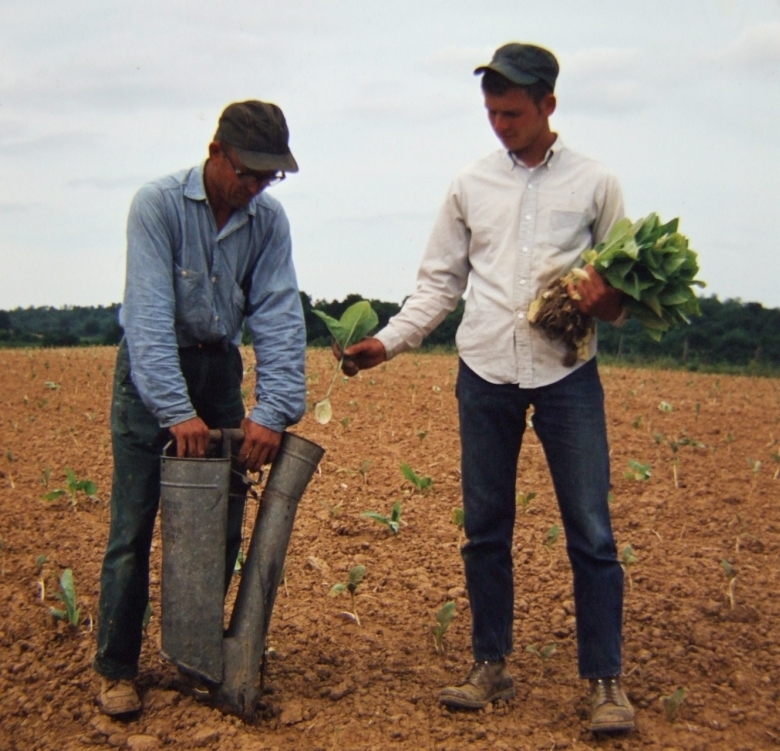
My parents have a beautiful view off of their deck in Scott County Kentucky. It overlooks several rolling hills of active fields and each year a different crop is planted. Over the years, we have watched the growth of soy beans, corn, hay, etc. But this year, for the first time, the farm owners decided to plant tobacco. Despite the controversy surrounding this staple of Kentucky farming, we enjoyed watching the different stages of development as the days of summer ticked by. At this point, the growth has slowed way down due to a lack of substantial rain in this part of the county. The plants appear to be stunted, and have started to bloom out way before the normal time. As my mother and I commented on its stunted growth and development, we realized that the farming traditions and experiences we had while growing up had indirectly taught us much about the tobacco growing process. Even though we were never farmers, we grew up visiting or living some of our lives on Kentucky farms. This meant helping to plant it, watching the little plants grow, watching the blooms appear at the top, watching the spray, followed by the turn of yellow leaves which marked the end of the summer season. As we looked at the leaves in her neighboring farm, we knew we were remembering loved ones in our past.
L-R: John, William (Bill) & Lawrence Beyersdoerfer

As it turns out, we also have several other tobacco farmers in our family tree. The family branches we were remembering came from the northern Kentucky region, on my Mother's side. Despite the steep rolling hills that presented severe challenges to farming anything, the farmers in this area embraced the tobacco crop. Within the Pendleton and Bracken Counties, we had family members in the Fliehmann(Fleeman), Beyersdoerfer, Cox and Watts branches that grew tobacco along with other crops. Ironically, we have several photographs from family or neighbor tobacco farmers posing with their crops proudly. Once my father married into the Watts family - a city boy from Cincinnati - his shutterbug tendencies went wild. The result was a wonderful treasure trove of photographs from the late 1960s - 70s that continues to enhance our family story. Regardless of which generation was being photographed, these farmers were very proud of their crops.

Of course, tobacco was not the only crop that provided sustainable income for these Kentucky farmers. With the German branches of our family near Foster Kentucky, their additional crops came in the forms of corn and grapevines. Bringing their Bavarian traditions to Kentucky in the mid-nineteenth centuries meant growing grapes and producing wine to sell in Covington. For our families in the Pendleton County area who were more from English/Irish ancestry, corn and dairy farming were their staples of choice. I hope to post more about the choices these farmers made as our family history collection has much to offer....but for now, tis the season of tobacco.....and despite any ill feelings toward this crop, for many it was just a way to survive. A way of life that is quickly fading.  

Saturday, March 12, 2011

Aerial Photography & Rural Cemeteries

We all know the unsurpassed usefulness of Google Earth for scrutinizing unfamiliar topography (including historical images), but back in 2002, our family needed older rural images to help in cemetery research. Several cousins from around the country and Canada got together to stage a cemetery intervention or attempted rescue in Bracken County Kentucky. After years of debating and combining genealogical research, a few of the cousins had found remnants of our Brandenburg/Hughbanks family cemetery at the top of a very steep hill near Foster. Due to the remote area of the cemetery, and the unfriendly stance of the current landowner, some of our research involved aerial photography.

Before I give a small report about the Brandenburg Cemetery, let me explore the use of aerial photography for cemetery research. At present, most states have quadrant coverage of current aerial photographs available for free online. Many of these sites are linked to current topographical maps and other studies posted by statewide government agencies. As a general rule, most of these maps and aerial photographs are fairly recent - usually within 10-15 years old depending on the agency posting the information.
However, when many of the older rural cemeteries were begun, they were done so during a time when the areas were much more agrarian. In most cases the land had been cleared for farming and well maintained in that manner for generations. It has only been within the past 30+/- years that these former fields have been abandoned, allowing the regrowth to obscure former markers. Having driven many backroads, I can tell you that a small stand of large clumped trees near a field or in the middle of a field is a strong indication of either a cemetery or sink hole. Sometimes the only clue to go on is the types of trees in the clump to hint at the purpose, until, hopefully, walking closer to the site can offer a view of fence or stone remnants. But what about the cemeteries we can't see from the road, or are not accessible even though we've heard about the possibility of its existence from the locals?
1965 aerial view of Foster and the Kennon Road area prior to the AA Highway construction.
This is when we turned to the older aerial photos available through local state storehouses. In this case we went to the Geology Library (now the Science Library) at the University of Kentucky to peruse through the older photos taken in the 1960s (some counties have photos as far back as the 1930s). In the Northern Kentucky area, farming was still the main occupation on these steep yet rounded hills. Therefore, the aerial photos from this timeframe gave us just enough visual information to see former households, assent routes, and in this case, former topography indicators prior to a state highway construction. These photos are original and in paper form just sitting in giant drawers. The staff had scanning equipment available to scan and send the photos to yourself at no charge.

For our case, they made all the difference. Due to the construction of the AA Highway, the original road had been cut in two, leaving the gradual incline cut off in one direction, and very far away in the other direction. About 20 years after the production of the 1960s photos, someone had purchased the gradual incline side, built a new house and assent in the form of a driveway, but would not allow their new driveway to be used as the egress to the cemetery. In essence, the cemetery had been cut off from any plausible access route. We all hiked straight up a dangerous quarter mile incline to get to the cemetery of our ancestors. Kentucky law states that landowners have to allow family to visit cemeteries, but any law surrounding how they allow access is vague, and since the driveway was new, they basically said, "no - find another way up there". Ironically, when we were up there, they called the local judge to try to have us arrested for trespassing, and the judge was allowed to use the driveway for access. Good times. BTW, the judge could not touch us as he informed the landowner of the law. He was just up there making sure we were family and not troublemakers.

The cemetery was also registered that day by the Kentucky Historical Society as a pioneer cemetery since at least one person buried there was born in the state prior to 1800 (James Hughbanks). We had a great time, even inviting a local preacher to conduct a small re-dedication ceremony, but the cemetery itself was beyond our means to save. The landowner had also parked a 1950s rusted out Chevy in the middle of our cemetery and refused to move it....which meant some of the stones could still be underneath. We found some of the main stones, but many were missing - some were "rediscovered" locally at a hunting club who had used them as stepping stones! We did the best we could....cleaned out brush, placed wooden markers there for later replacement, but funding was never found to properly restore this pioneer site. There is a Findagrave entry with photos of all the stones we found.
The moral of the story is: older aerial photos can be wonderful tools for not only locating cemeteries, but homesteads, access routes, tributaries and other distinguishable markers that could not be seen under current levels of brush. Thanks to cousin Katheryn Maddox Haddad for getting the cousins started on this adventure - we at least got it cleaned up a bit and documented for future generations!
CD

Saturday, June 12, 2010

Sepia Saturday - Looking at Anna

By all genealogical accounts, Anna Beyersdoerfer runs a high risk of becoming invisible to history. Known as the maiden aunt of our family, there are no pictures of her in a wedding dress, nor any of her holding babies. She had no descendants, and therefore, very few people to remember her. We have a few pictures of her, but none or next to none within the larger family gatherings. Anna seems to stand alone in artifact as well as she did in life. However, Anna recently made a grand showing that has piqued my interest in this very independent woman.

Born to John and Emma (Fliehmann) Beyersdoerfer in 1901, Anna was the youngest daughter of nine children. Her parents had a farm in Bracken County Kentucky, near the small town of Foster, which sits on the Ohio River. Both sets of grandparents, the Beyersdoerfers and Fliehmanns had large farms overlooking the river. Her family's small farm was tucked down in a valley known as Willow Creek. The steep hills of northern Kentucky meant a pretty challenging farm life, but her parents tapped into their German heritage and produced wine to sell in Covington as a supplement to their income.

According to census records, most of the children stayed on the farm to help well into their twenties. Marriage was usually the impetus to move on and begin a life for themselves, but when marriage did not appear as an option for Anna, she moved forward on her own, opting for life in the big city of Cincinnati Ohio. Her brother Lawrence and his family lived in Cincinnati as well, so she was not completely alone. However, she did not live with her relatives, but took a job as a domestic servant.

By 1930 she was residing in the home of Walter and Francis Klein up near Clifton. This couple apparently had no children and she was the only servant in their household. At the time, she was 28, and the Kleins were 44 and 38. Hardly elderly, this merchant couple also piques my interest. They must have had a decent size home to have a servant during the depression, yet, not a house full of servants, which demonstrated either a sense of modesty, or frugality in tough times. But at such a young age, with no children to care for, I can't help but wonder if they had a more exciting social life.

Skipping ahead to her death in 1988, we knew Anna had been a nurse most of her life. By 1951, she was listed in the city directory as a "nurses aide" at Bethesda Hospital. My mother visited her shortly before her death in Newport Kentucky, and she had a sharp, clear mind. She gave my mother details about the family history that we had never heard before. She included maiden names, burial locations, married names, etc. As an evident keeper of the past, her information turned out to be priceless as I began my own journey into our family history a few years later.

However, it is the time frame between about 1920 and 1951 that has set off my detective radar. An independent woman of the 1920s and 30s was not a common thing. Spinsters were, of course, fairly common, but Anna somehow did not fit that mold.

A few years ago, due to my main Journeys Past web site, a relative by marriage learned of my existence, and decided to send me some family artifacts they had in their possession. They were the family of Anna's brother Myron's wife. Ok, try to un-cross your eyes on that one! Anna's brother Myron married rather late in life to a woman names Eleanor, but they had no children. After Eleanor's death, her family found some items that belonged to Myron and they decided to graciously return the items to our family. After checking with the other Beyersdoerfer men, they unanimously chose me to be the recipient since they weren't all that interested in the family history - definitely a perk to being known as the family historian! I plan to write a piece about Myron soon, because his artifacts included some things from his service in WWII, and one picture in particular that had me up in the stacks of the library researching campaign locations....so stay tuned for that one.
Among Myron's things, was a photo of him and his sister Anna sitting on the front of matching cars. I could tell the cars were sitting at the farm on Willow Creek, and the back of the photo said "Myron & Anna, Brother & Sister, with our new cars, Ford bought same year, Richie Brothers auto Dealers took it." According to the license plates, the year was 1935, and both brother and sister look rather dapper in their fancy outfits and brand new cars. After a few minutes of awwing over this awesome photo, it suddenly hit me that Aunt Anna was a single woman in 1935. How could a single domestic servant make enough money to purchase a brand new car during thos tough economic times? I'm assuming Myron was still on the farm since family reports says he even lived there as long as Grandma Emma was still alive. But then, those don't exactly look like farmer duds. Interesting, since he would have been about 28 while she would have been about 33.

I'm not positive that Anna was with the Kliens in 1940, but in that year's city directory, Anna was still listed as a "maid", and living either in her own place, or in another family's household. Her new address was 2831 Vernon Place, which was in the same general Clifton area as her 1930 residence on Alaska Avenue with the Kleins. So needless to say, in 1935, she was still a domestic servant, and obviously a well paid one. I can't help but think there may be more to her story than she is telling us, but conjecture will only go so far until it reaches my frontal conspiratorial romanticized lobes, and loses all sense of reality.....so I will speculate no more.

Since researching her paper trail only created more questions, I started looking for more pictures of Anna. As I stated before, I'm having a really hard time finding her in the family group photos, but I did find a few more of her with two different men. Both men were from the area and about her age, but both went on to marry other women. I cannot say for certain that they were love interests, but in one photo from May of 1926, the two are sitting very close together and she is holding a small bouquet of flowers. She is obviously fairly young in the photos, no more than her twenties, but usually with that trademark tilt of her head and wry smile. I get the feeling I would have gotten along very well with the young Anna. I sense she had a tremendous amount of spunk and independence......or perhaps spunk and the determination to work hard enough to forget a broken heart? Sorry, couldn't help that one.

Even though I cannot remember meeting "Aunt Annie", as the younger generation called her, I remember her estate dispersal. We were allowed into a storage room full of shelves that were loaded with odds and ends. Her life was scattered about the room in the form of tangible objects. If she could have been there, what stories could she have told us about each item? Were there family artifacts there that were rendered silent as we passed by and therefore left to be sold to a stranger? My mother tried to locate things she thought looked old enough to be from the family. She picked up a depression era pink cherry blossom glass bowl, and a single glass goblet with bubbles in it. Several people in the room passed by a very large portrait that leaned against the shelves, until my mother recognized the face....it was Anna's mother, Emma Fliehmann Beyersdoerfer. Mom quickly brought it to the attention of my Grandmother (Anna's niece) Frieda, and they quickly saved Grandma Emma's portrait from the auction block. Reflecting back on the things we don't know about Anna, were there mementos among the possessions that spoke of lost or unrequited love? Sadly, or maybe appropriately, that remains Anna's secret.

CD
6/12/10
This is my first Sepia Saturday post - week #27! To join the fun, click here.

Sunday, May 9, 2010

For Those Who Mother Us...

In honor of Mother's Day, I pulled out this old family favorite from the Beyersdoerfer Collection. All of these women are Beyersdoerfer mothers holding, what appears to be, their children of near identical age. The photo was taken sometime around 1915 on the Beyersdoerfer family farm in Bracken County, Kentucky. I am very rusty on which woman is which, but I'll give it a shot: from R-L: Aunt Addie (Hiles) Beyersdoerfer, Aunt Rose (Beyersdoerfer) Pangburn, Aunt Nora (Beyersdoerfer) Reuss, Great Grandma Nellie (Cox) Beyersdoerfer, Can't remember the name of the lady with the cloth on her head - could this be Aunt Gladys - the wife of Uncle Charlie Beyersdoerfer?, Aunt Celia (Beyersdoerfer) Gosney. Needless to say, it must have been a long winter to have all of these babies born in the same season!

As an added highlight to this year's Mother's Day weekend, we are also celebrating the 90th birthday of my grandmother Bessie Louise (Pace) Daniels. She was born in Magoffin County Kentucky to Albert and Fannie (Connelly) Pace. Not only did she raise four of her own children, but in 1988 she (along with Grandpa Charles) was named Foster Parent of the year in the state of Ohio. Over the years she cared for over 60 foster babies.....and I mean babies - some newborn to a few months old! She's still going strong these days....going to church, shopping, and family functions.....and still playing mother to her Shih-Tzu - Sarah Jane.....you go Grandma!

Of course I mustn't forget my own Momma, Pamela (Watts).....the dearest, bestest and most loving Mother a kid could have! And believe me, my brother and I gave her fits while growing up! She too is still mothering us all the time while being very active in her church and tending to her half acre perennial garden. Being the daughter of farmers means she loves this time of year that allows her to be in the garden getting those fingers dirty!
So Happy Mother's Day to all those special mothers out there - those dear mothers of the past, or the dear ones of the present......we couldn't have done it without you!
C
5/9/2010

ShareThis

Related Posts Plugin for WordPress, Blogger...
 

Designed by Simply Fabulous Blogger Templates