Monday, August 15, 2011

Mystery Object - Candle Box?

I present, for your amusement, a box of mysterious origin and use. It is made mostly of a light metal, I'm guessing tin since a magnet does stick to it, and wood. The measurements are 12" long by 5" wide by 4.5" deep. I purchased this item back in the early 1990s at a Cincinnati antique store for $3.00. It had that lovely primitive appearance that I am still fond of even though it has passed out of style for many. My first thought was a candle box, based on its measurements and the way the lid hinges back to let whatever was inside, be retrieved without bending......but.....on second thought......is that really what it is? There are some odd design elements as I will display below. After you see the evidence, please give me your thoughts on what you suspect its original purpose might have been. 

Instead of a standard arched, extended piece that is flat enough to hang the box from the wall, like many candle boxes I have seen, this one has a heavy duty handle meant for carrying.
The lid is one metal piece that it beveled in design and attached at the very bottom. The three sides are made up of one piece of metal rounded and bent to make the box shape. However, the bottom (end and box bottom) are both made of wood panels.
The lid itself, is only connected at the base and easily swings back to open as one awkward panel - quite unlike many candle boxes I have seen where the lid is an inset wooden lid that slides in and out. There are two tiny holes at the top where a string-like latch must have been to keep the lid closed when not in use.
Here is the weirdest feature of all.....3 perfectly drilled holes in the back wooden panel. The holes vary in size, are not evenly spaced, and yet, if they were an accident (rogue child practicing with a drill for the first time), they were never puttied up, but rather painted inside, just like the rest of the box. My Mom once thought that due to its black paint, and odd holes, that it might have been a signal box of some kind. We even tried lighting a candle in it to see what happened with the holes.....odd experiment with inconclusive results.
No matter what it may have been, I continue to love it and have it prominently placed next to the cute little caned ladder back chair that I purchased at the Ewalt house auction in Bourbon County Kentucky in the late 1990s (for $8.00, can you believe that?). Every time I see this box, I still sense a mystery. So....your vote on this? I would also be interested to hear theories on age.

Friday, August 12, 2011

Hunting Wabbits...A.K.A. Warrens!

When I think of my Warren branch of the family, and our loss of contact within recent generations, I go through an odd transformation. It begins by getting inspired, then determined, followed by pulling their file for more research - but then my face eventually begins to take on that maniacal look of desperation as so wonderfully demonstrated by my friend Elmur Fudd. He is so representative of the genealogy search! He knows what he wants, he will not give up - nose down and moving forward - but sometimes missing his target as it sits and laughs at him - always taunting and being just out of reach! I apologize in advance for this note of a rather personal and specific nature. However, as the blogs get crawled by search engines, maybe someday, this entry will turn up in a cousin's search result to point them in my direction. I am searching for a specific group of the Warren family from the far Western Kentucky/Tennessee areas.

When I mean searching, I'm not talking about a record search, that I can do and have been doing on my own. I really would like to make some personal contact in the hopes of learning more about our family history as well as hoping they would have a photo or two from this side of the family they would be willing to scan for the rest of us abandoned cousins. Due to a family tragedy, my grandfather Roy Watts and his sister Estelle grew up in a Louisville orphanage with very little contact from the rest of the family. They were the children of James Thomas Watts(1891-1953) and Florence Warren Watts(1898-1923). For more on James' family history, see the previous post about his parents.

I will not plague you with too many details, but here is what we know:
Roy and Estelle's early childhood were spent hopping between Graves County Kentucky and Weakley County Tennessee. We believe the Watts side of the family resided on the Tennessee side of the area, and the Warren family on the Kentucky side - with some cross pollination across the border. Many of the orphanage records for the children have varying places of residence, birth, etc that reflect this transient pattern. We have heard that the two sides of the family did not get along because when this young couple got married (James and Florence m.1914), her Warren side did not approve of her Watts choice. Florence died from tuberculosis at the age of 25 after giving birth to a third child: James Thomas - who either died after being adopted by a Garrett woman from Alabama, or put in another orphanage down south - based on some conflicting family reports - apparently there was a scandal attached to this adoption and we have only gotten a few willing blurbs about the incident.

Roy and Estelle's father was still alive, but handicapped and had to move around a lot in order to find work. Since both sides of the family were at odds, Florence and James' wish at her death was to put the children in a home for a better chance. After entering the Christian Children's Home in Louisville, which was quite far away from the remaining family units, there was minimal contact with the children. James wrote some letters to his children, as did Florence's sister Mae Warren Wiggins. **Aunt Mae was in contact with the family again in the 1980s before her death, but we've even lost contact with her children.

Roy visited the Mayfield area back in the 50s or 60s to reconnect with some of the family, but sadly, no one brought forth much about the family, or he didn't take any notes. Roy and Estelle had a picture of their father since he didn't pass away until the 1950s (seen here), yet, went all of their lives without any picture of their mother. Mention was made of pictures existing, but none were ever shared - which would have been hard to do back then. Roy said one member of the family showed him a small newspaper clipping with a school group photo - which included his mother as a teenager. He spoke of this photo a lot and always told me I resembled his mother (my great-grandmother), and we assumed it was because we were told she had blond hair - my hair was blond when very young, and light brown when older. However, none of us have seen this photo, let alone any other photos from the elusive Warren clan.

My appeal goes out to any living cousins out there that may be descended from this bunch. The family unit that Florence came from is as follows:

Parents:
John and Asalee (Azalee) Gray? Warren

Children:
Arthur
Florence
Mae (married a Wiggins)
Edna (also married a Wiggins)
+ a few others, whose names I don't have on hand at the moment.
This family group can also be seen here in this 1900 Graves County Kentucky census clip:


I have some notes (oral accounts) that list the parents of John as James and Cordelia (?) Warren. As for Asalee above, we heard she was a Gray and in the above census household, Timpa Gray, the "mother in law" was living with them at the time. We had heard her name as Tempy, but always assumed it was short for Temperance. Imagine our surprise when I found this amazing tidbit in Findagrave:

Birth: Mar. 7, 1827
Death: Feb. 17, 1903

Tempay Warren Gray was a 73 year old living with her daughter Azalee and husband John Warren listed in the 1900 census.
Inscription:
wife of R. Warren and E. Grey
Burial:
High Hill Cemetery
Graves County
Kentucky, USA

Soooo, she was married to both a Warren and a Gray...thanks Grandma for making as this clear as mud! This one alone is why I need to make some physical field trips down to the home counties....planning for a trip soon, Mom is chomping at the bit!

In order to snag some more cousins, here is a couple of obits that might ring a bell: one for Arthur Warren, Florence's brother, and one for Arthur's son Aubrey aka "Jay" in Calloway County Kentucky - both died in 1983.


As a final note, please do not be alarmed by Elmer Fudd and his shotgun, I am not literally hunting you as he would.....but we would be thrilled to restore contact to this branch of our family.
Btw, many thanks to the Watts cousins out there - you know who you are - who found my web site years ago and sent me some wonderful pedigree info and photos of our ancestors!
To the rest of my readers - thank you for the long indulgence. Now, back to our regularly scheduled programing.
**Newspaper articles taken from the Mayfield Messenger (1923,1983), with the exception of the last obit from the Murray Ledger Times.

Thursday, August 4, 2011

Lincoln Park Legacy - A New Journey

Telling the story of the Lincoln Park Baptist Church will require many voices. My voice, encased in my personal experiences with this institution will be here at my blog. However, the new Lincoln Park Legacy blog will be the newsfeed for the many voices I hope to restore to our collective memory. After my first segment of the Lincoln Park story told here, I encourage you to visit the new and official blog of the project to learn more and follow along as we uncover historical gems and past identities.

My introduction to Lincoln Park Baptist Church in Cincinnati Ohio came through my parents and grandparents. My grandparents were members of this church between the span of the late 1950s to the mid-1980s. My parents were married here, yet they did not belong to this congregation as they made their own family. Actually, many of my family members were married here: My aunts and uncles, and a few cousins.

Among my personal memories, I can relate a few: visiting many times with the grandparents, attending Sunday school on occasion with my cousin, attending weddings, and two favorite memories that my family love retelling when they need a good laugh. The time when I was 3 years old and had an accident that made my grandmother think her water pills were playing tricks on her, and the only time I was ever asked to be a flower girl in a wedding – I fainted dead away while standing so long, and hit my head on the seat of the hard wooden pew. This was my cousin’s wedding, and my aunt supposedly has an audio tape of the horrible, loud “bong” that my hard head made as it hit the pew. Have no fear, there were no lasting mental effects – at least that is what they continued to tell me over the years.

Back in 2007, my Aunt, who was still a member of this church, invited my parents and I up to visit during the “homecoming” celebration. This yearly event was special in 2007 for a couple of reasons. 1. The Church was celebrating 165 years of being a congregation. 2. This would probably be their last celebration because the building was about to be sold and the congregation had voted to merge with another in order to survive in any capacity. There was a third reason I was called up – due to the anniversary, all of the historical items of the church’s long history would be on display, and with my Special Collections training/history degree/genealogy experience, they could use an expert pair of eyes. At this point, the congregation knew they had a unique collection, but had no idea what to do with it once they merged with another church.

My visit in 2007 was thrilling. I instantly fell in love with this collection. It was rich and fairly well preserved. There were stories of women missionaries to China, immigrant congregations, healing ministries, hardships through the decades of American history, and just plain adorable social tidbits. After snapping some initial photos of the collection, I recommended some options if they intended to keep the collection, or if they planned on donating it to another entity.

Within the next year, I was invited back to take a closer look, give even more detailed preservation advice, and this time, advise on packing. By now, the church building had sold, and the moving had already begun. Knowing the long history of this church, I was saddened by these turn of events.

There were many in the congregation that understood the scope and value of this collection, but they were not ready to part with it. They had the foresight to plan for preserving the material, but were unsure how to go about this properly. They set aside some money to purchase preservation material and to house the items in an environmentally controlled space. However, after a few years of debating, a mold outbreak, lack of space, and re-allocation of some of the money, plans were altered by necessity. This is where I came back into the picture within the capacity of Pastology.
Under our normal operating procedures, we advise on how to set up digitization efforts in-house, in the hopes of preserving and digitizing items on a long term basis. With the Lincoln Park remnants, circumstances were changing fast, and it was evident that a long-term digitization/preservation effort was not possible with the few volunteers they had on hand. Also, their new facilities were not conducive to maintaining the items securely. Extra help was needed, and due to our unique relationship, Pastology agreed to digitize off-site, with each newly digitized batch of documents being donated to a local historical society, for longterm preservation of the original material. Another reason for this choice was the desire for quick and full access of these documents for the remaining members who are aging fast. Part of this new project will also include a portion devoted to oral history. Hopefully we can add to the collection with some oral history interviews in the near future.

That is about it for my personal connection to this collection. When I say Pastology will be digitizing the collection, that means, me, myself and I. This one is near and dear to me, so I’m taking this one on all by my lonesome. Disclaimer: Pastology is under contract and is being paid for the digitization efforts…..we are NOT however, being paid to wallow in how much fun wading through all of this content has already proven to be! What is it they say about a pig wallowing in mud? Sometimes it feels like that with the dust, and yes, a bit of mold from time to time, but I am as happy as that proverbial pig!

To follow along on the journey and keep tabs on the wonderful historical gems we uncover, please consider following our newest blog Lincoln Park Legacy. We also have a new twitter account: @oldlincolnpark. Once the newly digitized documents are entered into Pastology, they will be free to access. For any of you with Cincinnati relatives/ancestors…..you will want to keep tabs on this collection. The congregation was downtown for over a hundred years with as many as 1000 members at the turn of the century. One of the most fantastic things we have to digitize is a large number of completed member cards, some as far back as the 1920s. Many new Romanian and Hungarian immigrants attended this church for sometime as well…..and that is just the tip of the iceberg!

So far, my favorite serendipity moment:

I was allowed to come take charge of a few document tubs at a time. Nothing is in any order anymore, so I did poke through some of the collection to create a tub with some of the oldest things first – they will need the quickest preservation care. As soon as I arrived home with the tubs, I grabbed a few files to look through. One photo in a clear sleeve slipped out on top of the others – the subject: an adult Sunday school class from the 1950s – in the front row – my grandparents - well at least Grandpa and half of Grandma.....but still a fun moment!

Sunday, July 31, 2011

Tobacco Time

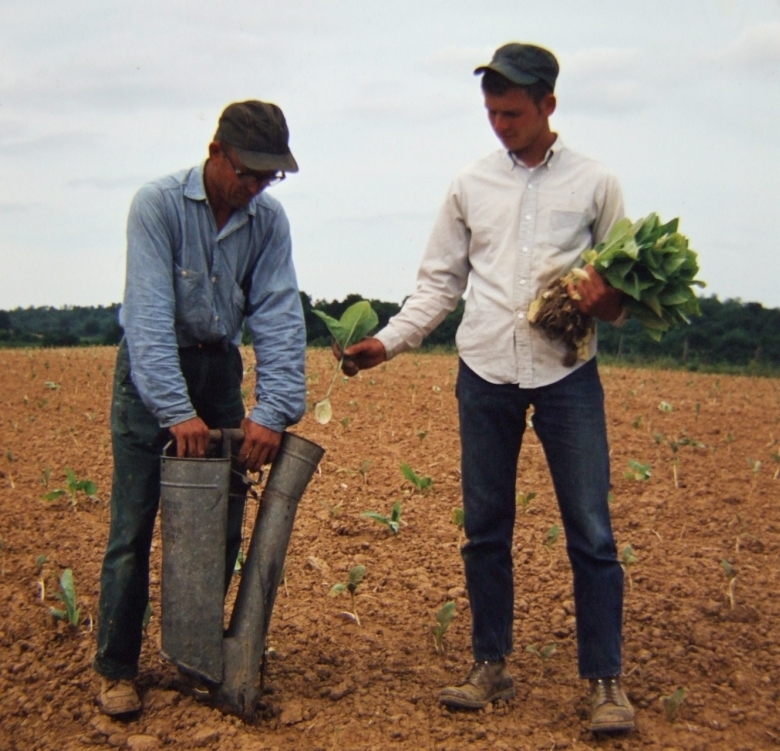
My parents have a beautiful view off of their deck in Scott County Kentucky. It overlooks several rolling hills of active fields and each year a different crop is planted. Over the years, we have watched the growth of soy beans, corn, hay, etc. But this year, for the first time, the farm owners decided to plant tobacco. Despite the controversy surrounding this staple of Kentucky farming, we enjoyed watching the different stages of development as the days of summer ticked by. At this point, the growth has slowed way down due to a lack of substantial rain in this part of the county. The plants appear to be stunted, and have started to bloom out way before the normal time. As my mother and I commented on its stunted growth and development, we realized that the farming traditions and experiences we had while growing up had indirectly taught us much about the tobacco growing process. Even though we were never farmers, we grew up visiting or living some of our lives on Kentucky farms. This meant helping to plant it, watching the little plants grow, watching the blooms appear at the top, watching the spray, followed by the turn of yellow leaves which marked the end of the summer season. As we looked at the leaves in her neighboring farm, we knew we were remembering loved ones in our past.
L-R: John, William (Bill) & Lawrence Beyersdoerfer

As it turns out, we also have several other tobacco farmers in our family tree. The family branches we were remembering came from the northern Kentucky region, on my Mother's side. Despite the steep rolling hills that presented severe challenges to farming anything, the farmers in this area embraced the tobacco crop. Within the Pendleton and Bracken Counties, we had family members in the Fliehmann(Fleeman), Beyersdoerfer, Cox and Watts branches that grew tobacco along with other crops. Ironically, we have several photographs from family or neighbor tobacco farmers posing with their crops proudly. Once my father married into the Watts family - a city boy from Cincinnati - his shutterbug tendencies went wild. The result was a wonderful treasure trove of photographs from the late 1960s - 70s that continues to enhance our family story. Regardless of which generation was being photographed, these farmers were very proud of their crops.

Of course, tobacco was not the only crop that provided sustainable income for these Kentucky farmers. With the German branches of our family near Foster Kentucky, their additional crops came in the forms of corn and grapevines. Bringing their Bavarian traditions to Kentucky in the mid-nineteenth centuries meant growing grapes and producing wine to sell in Covington. For our families in the Pendleton County area who were more from English/Irish ancestry, corn and dairy farming were their staples of choice. I hope to post more about the choices these farmers made as our family history collection has much to offer....but for now, tis the season of tobacco.....and despite any ill feelings toward this crop, for many it was just a way to survive. A way of life that is quickly fading.  

Saturday, July 16, 2011

Summer Recipe - Ripe Peaches

Ok, so this is not a real recipe, but I just couldn't help myself. There are some food experiences that are infused with memories - via touch, taste and smell - so powerful, they transport you back in time. For me, ripe summer peaches are one of my special food memories. My Watts grandparents had a large dairy farm in Bourbon County Kentucky that was sprinkled with various home grown produce. They had a huge vegetable garden just behind their house, which brings back both wonderful and painful memories (those are way too many beans Mamma!), but surrounding the vegetable garden was a spattering of fruit trees/bushes. There was a small orchard diagonal to the garden, next to an old horse barn, that had cherry trees, blue berries and grape vines on the old wooden black fence. But nearer to the house was a very mature peach tree.

Peaches in Kentucky can be hit or miss. Sometimes the frost gets the blossoms just when they are getting ready to produce the fledgling peaches, or when they do make it, letting them ripen is also risky, since deer tend to love those ripe peaches as much as we do! During those rare summers when we happened to be visiting during a year when we hit the ripeness right on target, we were blessed with a wonderful treat!

So, what was the grand recipe?
  • Ripe peaches.
  • An old kitchen knife (crooked and worn well).
  • A small china bowl (cereal size works well) - with or without pattern - but chips on the sides might be a very important ingredient. Picture shows my bowl of choice - Pappa's favorite cereal bowl. 
  • Granulated sugar and a spoon (crooked/worn spoon is also a must, but sugar may be in a cup or bring out the trusty sugar bowl with chipped lid).
  • Lots of napkins to catch the juice!
Instructions: slice up that peach into nice bite-sized portions - leave the skin on! Pour some sugar into your bowl....then.....dip those peach slices into the sugar before placing them into your mouth. If outside, on a summer day, close your eyes and breathe in that hot summer air....and remember those sweet memories.
Come on! The summer is only half over! Go get some ripe peaches!
C

Friday, July 15, 2011

Inferential Genealogy - Conclusion

After a pretty long hiatus of conferences, birthday trips, a sick cat, brief personal illness and just plain needed vacations, I am trying to get back into the swing of things. All of the above prevented my full investment into the final portions of the Inferential Genealogy Study Group in Second Life, but I did go through the final cases, and attended the wrap up discussion (previous post). Before moving on to other genealogy subjects, I thought I would post a final word on how the project went overall, and some of my observations about how Second Life enhanced this typically internet-only course.

As mentioned in my earlier posts, Dr. Jones' series on Inferential Genealogy is a free instructional tool available on the Family Search website. You may take this course at anytime, as long as you have a live internet connection. Second Life was only the method we used to take the course as a group, in order to discuss our experiences, and bounce ideas/suggestions off of each other. As we met to discuss our experience for each case study, it became quickly apparent that there were some technical difficulties with this particular course. As Dr. Jones took the researcher through the case documents to show them the pertinent pieces of information in order to move to the next step, the tech visuals were not in agreement. In several cases, the "reconstructed" document portions were missing the particular information that Dr. Jones was referring to.....and in some instances, the surnames listed were completely wrong.

Our gracious host, Clarise Beaumont (aka Dear Myrtle), had attended Dr. Jones' Inferential Genealogy seminar in person a few years ago, and she said these discrepancies we were seeing were not typical of the real course. This inspired the group to take notes detailing the errors we discovered, in order to pass on to Dr. Jones as a feedback measure. We were hoping the feedback would allow Family Search to change the visual document examples to better match the verbal/instructional portions of the course. An additional goal of this group arose as we discovered how helpful this course would have been if the technical difficulties were remedied. Therefore, the group produced a report to submit to Dr. Jones, giving both positive and critical feedback.

Overall, everyone had a great time - even if it was very frustrating when weeding through the discrepancies. But it reminded us all how tenacious we are when conducting research. The discrepancies sometimes made us only try harder - which was sometimes quite comical. When meeting back as a group, we had to reassure each other that we were not half blind, nor going crazy when things didn't add up to the verbal conclusions Dr. Jones was making. We also came away with many positives and lessons learned. For myself, my big positive with this course was learning to slow down my research methods to document the inferential conclusions I was making. My habit of mentally evaluating a clue and moving on to a next document or step is sometimes so second nature that it can happen in a few seconds. However, when passing on my research to the next generation, I need to document the inferential conclusions or assumptions I made during the course of my research. That way, each step is made, understood, and more legitimately argued. We grow much closer to the proof standard by documenting each step - especially when dealing with inferential steps since we know inferential knowledge is based on connecting the dots between known information to draw conclusions about the information that is missing. Another great lesson learned was the use of spreadsheets to map out your results my surname, individual and timeframe. It was interesting to see families change spellings, etc as they moved around.

For those you interested in following this inferential journey online, I'm not sure I would recommend this course to beginners - at least not until they fix the technical discrepancies. As for Second Life, events are happening each week in the genealogy areas - Chats, instruction, etc. Feel free to join in and bring some of your problem research to the group. They are all very helpful and love to chew on genealogical challenges. If you are interested in series study such as the one we just finished, Clarise Beaumont is planning a new one that will begin sometime in October, so keep an eye on the group calendar!  

See you in-world!
C/Sif

Saturday, June 25, 2011

A Change of Pace

As this time of the year rolls around, a group of faithful family members gather for their yearly reunion up in the Portsmouth Ohio area. They are all descendants from one branch of the Pace family.....a branch that has two distinct histories....one in Eastern Kentucky and one in Southern Ohio.
The Pace family (L-R: Pearl, Albert, Challie, Fannie, Alberta, Vearl,
Dorie, Gracie Pace Adkins with Husband Raleigh Adkins and two children.)
This Pace story is one of hardship, determination, love and faithfulness. It begins in the Eastern Kentucky Mountains - and exemplifies the rich Appalachian spirit that is so often mocked simply because of their humble way of life. Within the areas of Magoffin, Floyd and Johnson Counties, the Pace and Connelly families united with my Great Grandparents, Albert Pace and Fannie Conley (Connelly). It is said that Albert was a descendant of the early pioneer Richard Pace of Jamestown Virginia, and Fannie the descendant of Captain Henry Connelly of the American Revolution. Within the mingled generations it has actually been discovered that both are descendants of the illustrious Captain, but very far back down ye olde family tree - I better not hear any Eastern KY snickering about that one!

Pace homestead in Bear Tree,
Magoffin County Kentucky
This couple produced many children, and several of their descendants were very faithful in interviewing the children of Albert and Fannie. According to some of the family interviews, Albert and Fannie were greatly admired for their hard work and love of family. They made their home near Salyersville, Magoffin County,Kentucky, in a small area known as Bare (Bear) Tree. Growing up, I always heard Great Grandpa Albert referred to as "Prince" Albert Pace. As an adult, this term always perplexed me because I was pretty sure that wasn't his real name. However, caveat observed - I don't have his vital records, so, Prince could really have been part of his name. Ironically, when a cousin passed along this photo of Albert, all fancied up, I wasn't surprised that the "Prince" portion stuck to his memory. Albert did not live to be an old man, but died rather young and with a full head of hair - which I thought was interesting, since he never looked like the Prince Albert tobacco can image - but when looking at a younger image of the real Prince Albert, the "Prince" label made complete sense!

Tale of two Princes: Prince Albert Pace (1874-1923) and Prince Albert of Great Britain
According to the oral accounts, Albert was a man of many trades. He worked in the "oil fields", he worked in the mines, he "stacked whiskey frames", and according to the census, he was a farmer. All of the accounts from his daughters describe a loving and cheerful man. His daughter Sarah remembered him as a very devout man: "Everyday before he walked the many miles to work he would go to a spot behind our little house, beside a big tree. There he would stop, on bended knee and pray for his family. The spot where he prayed was worn bare from the pressure of his knee on the ground. For many years after he died, the place stayed bare and the print of his knee was there. I always thought that meant he was still watching out for me." Unfortunately, Albert, aka "Poppy" as his children called him, died from an unknown illness in 1923 around the age of 51. At the time of his death, he left a pregnant wife, eight children and one grown daughter from a previous marriage with two+/- grandchildren.

Fannie Lou Conley Pace
Cottle Malone (1882-1956)
After the death of Albert, Fannie's life changed completely. She worked as many odd jobs as she could cram into one day while taking care of her children. The memories surrounding these years include the image of her staying up late at night to do mending by the fire as part of her local paid duties. Instead of marrying again right away, Fannie gave birth to Georgie, four months after Albert's death, but then had to bury Georgie, 22 months later. Not long after Georgie's death, Fannie's two oldest boys learned about work up in Ohio and convinced their mother to take the entire family to Wheelersburg, a suburb of Portsmouth Ohio. Historically, this was a common move for many in Eastern Kentucky at the time. Factories were growing by leaps and bounds up along the river, and the number of jobs grew right along with them.

Not long after settling with her young daughters in a small dwelling near Meade, Fannie married their landlord, Bill Cottle. During these years, she also ran a small store, and faithfully attended a local Pentecostal church in the area. After Bill died, she married a man by the name of Malone, but kept working hard until her death in 1956.
Meade Pentecostal Church
Another consistent memory associated with Fannie was her kind nature. All of her children remember her very fondly. And so, after this northern migration, all of her children and descendants stayed north of the river, for the most part. I think we might be the only ones who returned to Kentucky - many decades later. For this reason, the family reunion is always held near the Portsmouth area each summer. If you recognize this clan and wish to join in the reunion fun, just contact me directly and I can give you the particulars.

Many thanks to my Pace cousins for keeping our oral history alive: Carolyn, Jodi, Brenda, Marcia, Bob, etc. If it wasn't for you, we wouldn't know the rich heritage that comes from this side of our family. For additional connections to this branch, the connected surnames include: Salyer, Caudill, Musick, Crace/Adkins.
Albert and Fannie's children at a Pace Reunion years ago.

ShareThis

Related Posts Plugin for WordPress, Blogger...
 

Designed by Simply Fabulous Blogger Templates